
Creating Patterns
Amigurumi designer
Build a crochet animal from parts in 3D, size and colour it, move the parts, and read the round-by-round pattern the designer writes for you.
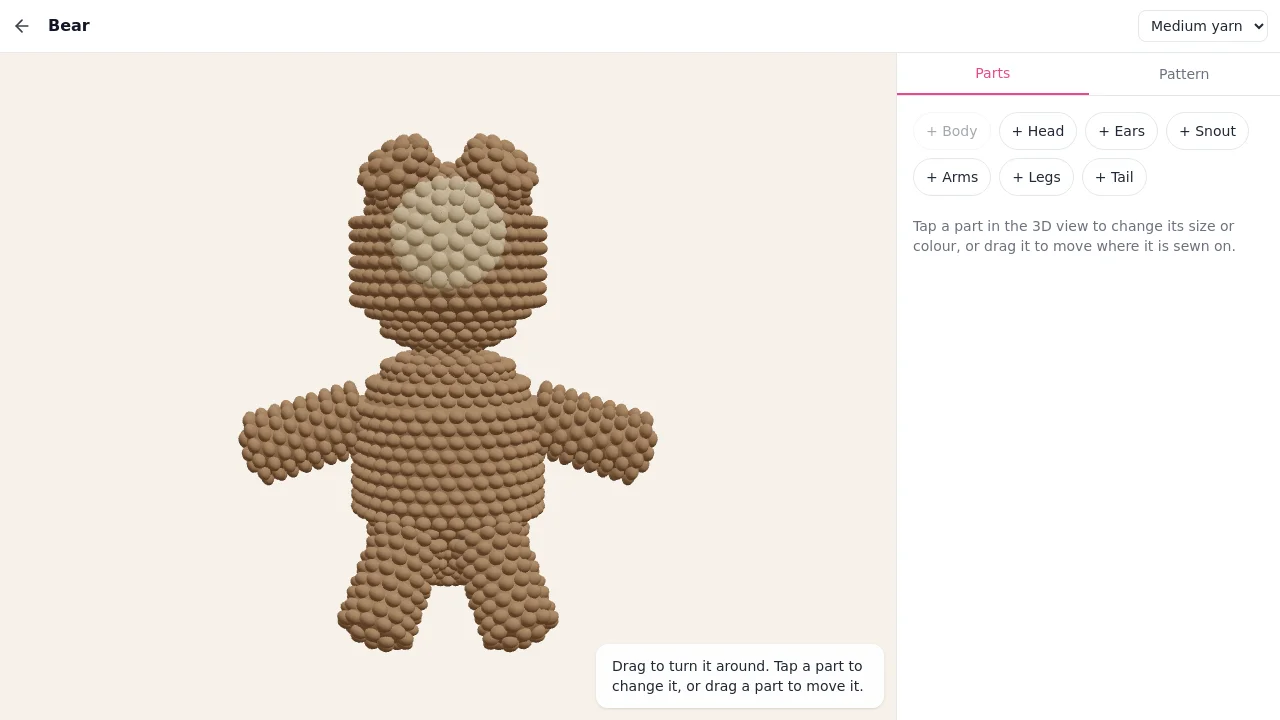
The amigurumi designer lets you build a crochet animal out of parts in 3D and writes the pattern for it: every part round by round, “make 2” for pairs, stuffing notes and where to sew each piece. Start it from New project, pick Amigurumi, or go straight to knytstudio.com/amigurumi.
Start from an animal
Tap Bear, Bunny or Cat and a complete animal appears, ready to change. “Start from a body” gives you an egg-shaped body and nothing else. Drag on the empty background to turn the animal; pinch or scroll to zoom.
Change a part
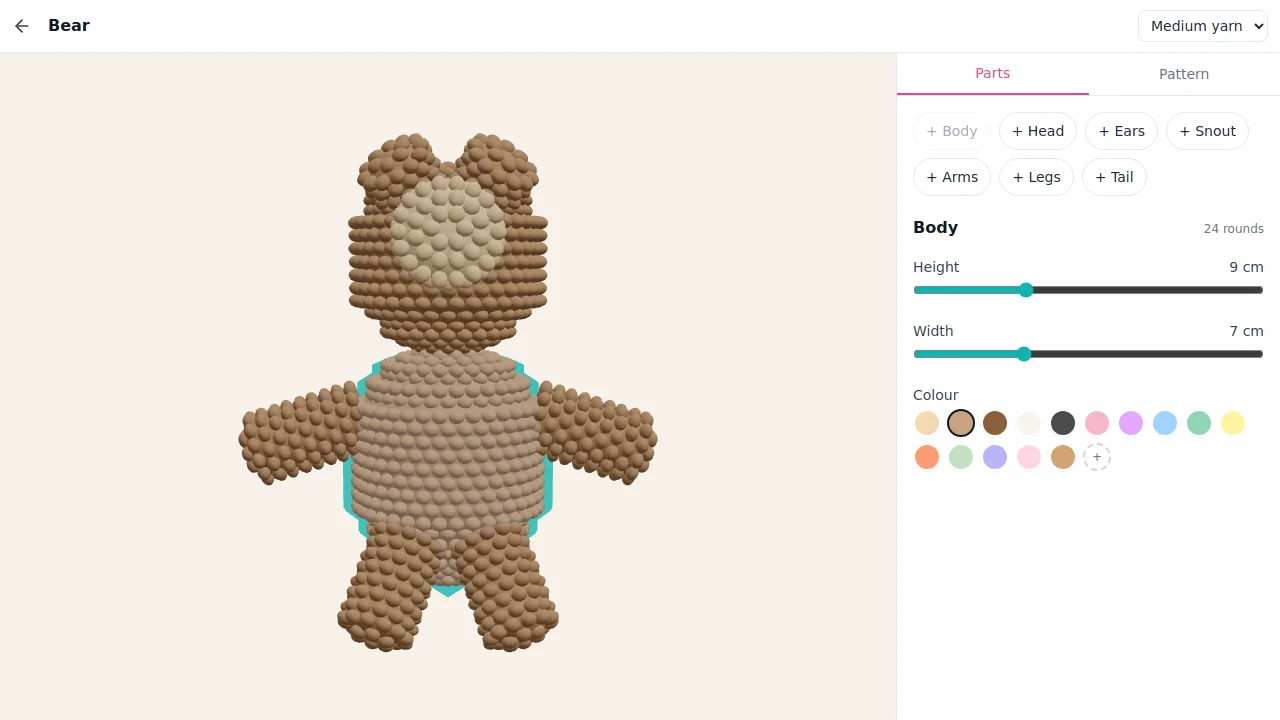
Tap a part and it gets a teal outline. The panel shows its sliders, in centimetres: a head has one size, a body has height and width, arms and legs have length and thickness. Below the sliders is the yarn palette, and a plus for any colour you like.
Arms, legs and ears come as mirrored pairs and change together. To make them different, tap “Unlink the pair”. Remove takes a part away, and its twin with it.
Move a part
Drag a part over the body and it slides along the surface; its twin mirrors the move on the other side. Where you leave it is where the assembly notes tell you to sew it: “Sew the arms to the body at round 9, on opposite sides.”
Add parts
The tray adds parts: a head needs a body first, ears and a snout need a head. New parts land in a sensible place and you drag them from there. A tail is a cone, so it doubles as a long bunny ear or a horn; a snout is a flattened half ball.
Pick your yarn
The yarn selector in the header has thin, medium and thick. Every part is rewritten for that yarn and the 3D preview redraws, one bump per stitch, so you see the gauge change.
Read the pattern
The Pattern tab lists each part in the order you would make them, with the stitch count after every round. Tap a round and it lights up on the animal, so “Rnd 9-16” is never a mystery. Copy the pattern to your notes or print it.
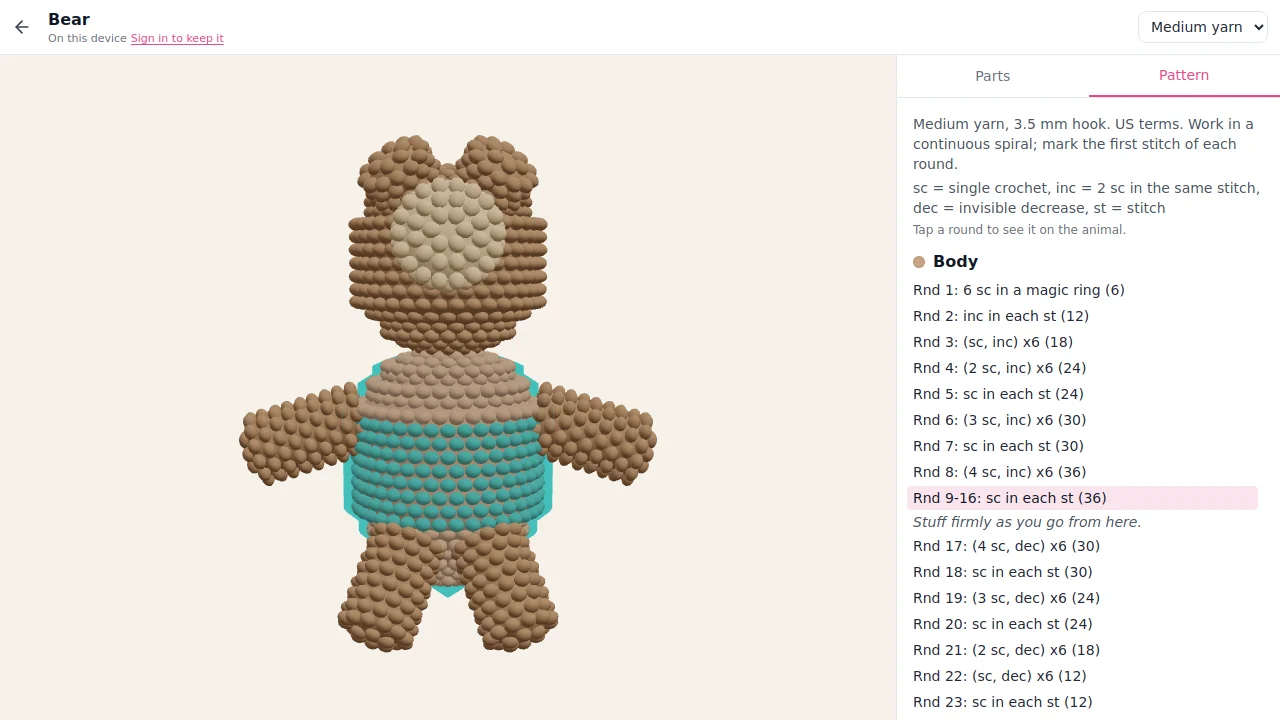
Everyone sees the first part in full. “Get the full pattern” goes through the same door as every other export on Knytstudio: sign in, and the first pattern is free.
On a phone
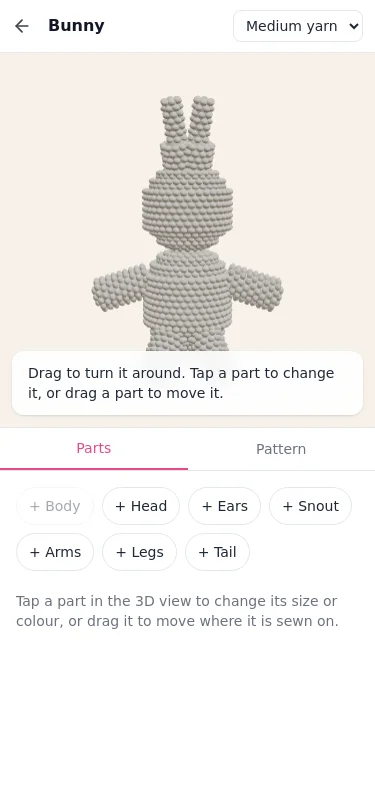
The 3D view sits above the parts panel. Turn the animal with one finger, pinch to zoom, and use the big buttons in the tray. Everything else works the same.
Free patterns to start from
The bear, the bunny and the cat are published as complete free patterns, each with a link that opens that animal in the designer. If you want to know why the rounds look the way they do, read why every amigurumi pattern goes 6, 12, 18, 24.
Frequently asked questions
Do I need an account to design?
No. Designs are kept on your device while you play. Sign in and they save to your account, appear on your dashboard and open on any device. The full written pattern uses the same gate as every export: the first one is free, then a credit, a one-off unlock or Pro.
Which stitches does the pattern use?
Single crochet only, in a continuous spiral from a magic ring, with increases and invisible decreases, in US terms. Every round ends with its stitch count in brackets.
Can I use thicker or thinner yarn?
Yes. The yarn selector in the header has thin (2.5 mm hook), medium (3.5 mm) and thick (5 mm). Change it and every part is rewritten for that yarn; the sizes you set in centimetres stay the same.
What if I want a part the tray does not have?
Combine what is there. A tail is a cone, so it also makes long bunny ears or a horn; a snout is a flattened half ball, which works as a paw pad or a muzzle. Tell us what you miss and the tray will grow.
Try it yourself
The Knytstudio editor is free to use in your browser. No install, no signup needed to start.
Open the editor